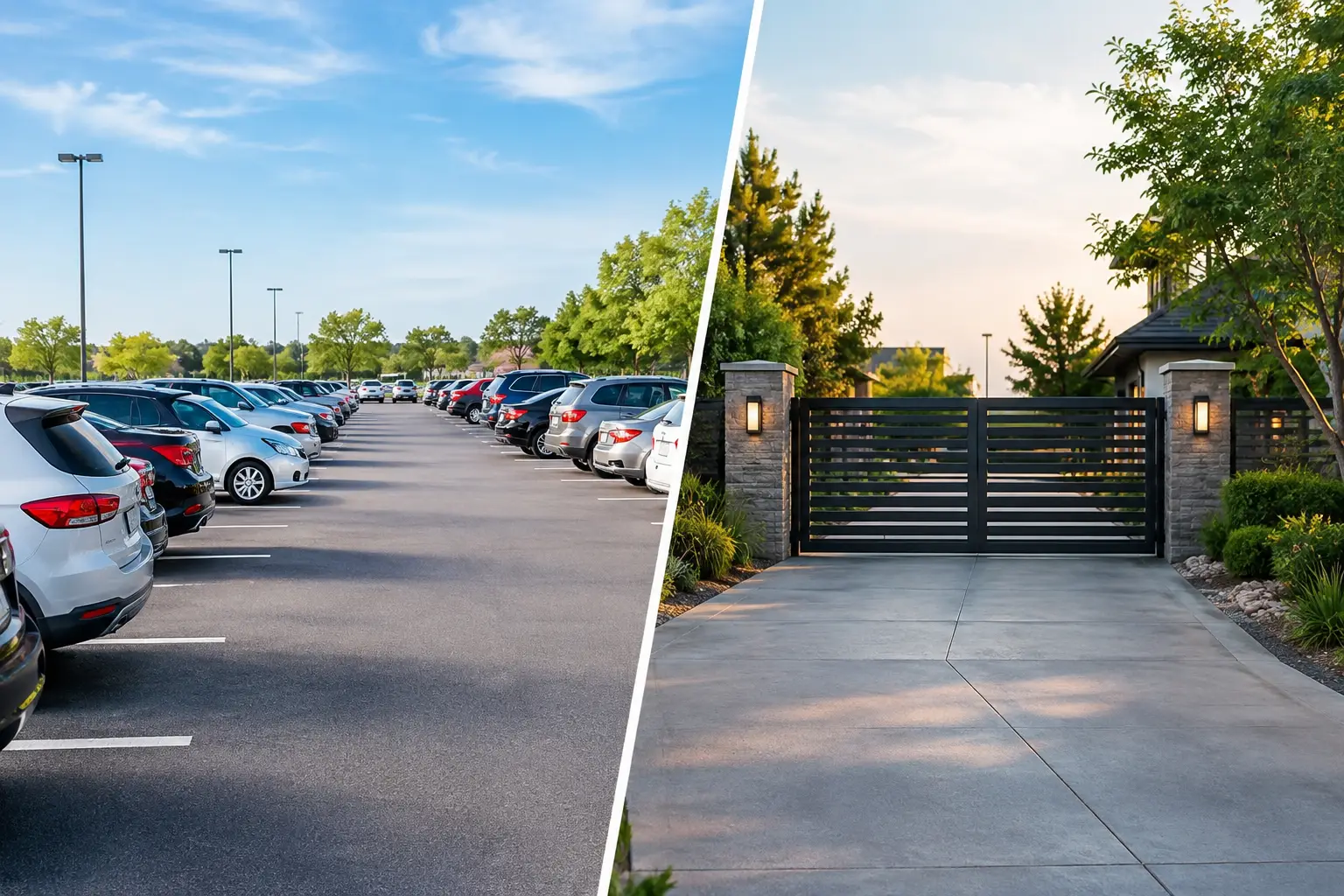
A cheap public garage is not a bargain if you circle for 20 minutes, arrive late, and still walk six blocks in the rain. That is the real question behind public parking versus private access: not just where you can leave a vehicle, but how reliably a spot fits your time, destination, and routine.
Public parking has a clear role. It serves the broadest number of people in busy places, often without planning ahead. Private access offers something different: a known space, closer to where you need to be, available on terms that work for a specific driver or user. Neither option wins every time. The better choice depends on how often you need the space and how much uncertainty costs you.
Public Parking Versus Private Access at a Glance
Public parking includes city streets, municipal lots, garages, airport facilities, and commercial parking operations open to the public. It is designed for volume. You pull in when space is available, pay by the hour or day, and leave when you are done.
Private access means using a space controlled by an individual, property owner, landlord, or business. That could be a driveway near a stadium, a reserved lot space near an office, a garage space by an apartment building, or a paved area beside a local business. Access is arranged directly or through a marketplace.
The practical difference is simple. Public parking gives you availability that may be broad but uncertain. Private access gives you a specific spot with more certainty, though it may require advance coordination.
For drivers, that distinction matters most when time is tight. For property owners, it creates an opportunity: an empty driveway or underused lot is not just unused pavement. It may be the nearby answer to someone else's daily parking problem.
When Public Parking Makes Sense
Public parking is often the right call for one-off trips and flexible schedules. If you are heading to a restaurant district on a quiet weekday, visiting a neighborhood with plenty of open street spaces, or making a quick errand, finding a public spot may be easy enough.
It can also work well when your destination changes frequently. A salesperson traveling across a metro area, for example, may value the ability to park near different appointments without committing to a recurring location. Public garages can provide covered options downtown, and municipal lots may offer reasonable day rates in smaller cities.
The downside is that public availability is rarely a promise. A space that was open last Tuesday may be full today because of a concert, construction, a game, street cleaning, or a change in local restrictions. Posted rates can also be misleading. An hourly rate may look manageable until a delayed meeting turns a two-hour visit into a full afternoon charge.
Street parking brings its own trade-offs. It may be inexpensive, but it can involve time limits, permit zones, towing rules, loading areas, and restrictions that vary block by block. It is useful when you can read the signs, watch the clock, and accept a little uncertainty. It is less useful when being late or getting ticketed creates a bigger problem than the parking fee.
Why Private Access Changes the Routine
Private access is built for the trips you make again and again. Think of the employee who drives to the same downtown office three days a week, the hospital visitor who cannot risk circling a full garage, or the resident whose building has fewer spaces than tenants. In each case, a dependable spot can remove a small but repeated source of stress.
The biggest benefit is certainty. Instead of hoping a space opens up at the right time, you know where you are going before you leave. That can make a private driveway, designated space, or small local lot more valuable than a larger garage farther away.
Distance matters, too. A spot two blocks closer can mean a faster school drop-off, an easier commute after dark, or less strain when carrying equipment, groceries, or a child seat. The best parking choice is not always the lowest listed price. It is often the one with the lowest total cost in time, walking distance, fuel, and frustration.
Private access can also make sense for longer stays. A traveler leaving a car near an airport, a commuter parking near a transit station, or a neighborhood worker with a regular schedule may prefer a defined space over changing daily rates. The terms should be clear: where to park, when access begins and ends, whether the space is reserved, and what happens if a schedule changes.
Cost Is More Than the Posted Rate
Comparing prices starts with the fee, but it should not end there. Public parking can be less expensive on a slow day, especially if street parking is available. Private access may carry a higher upfront price in some locations because the space is reserved and closer to demand.
But an honest comparison includes the hidden costs. Add the minutes spent searching, extra driving, surge pricing near events, risk of citations, and the possibility that the nearest garage is full. If a driver loses 15 minutes every workday looking for parking, that is more than five hours a month. For many people, a predictable spot is worth paying for because it gives that time back.
For providers, pricing should reflect the value of location and reliability without becoming complicated. A space near a commuter rail stop may be useful during weekday mornings. A driveway by a venue may be most valuable on event nights. A business with unused evening capacity may serve nearby diners or employees. The point is not to treat every space the same. It is to match a real local need with a practical rate.
Safety, Rules, and Clear Expectations
Public facilities may offer lighting, attendants, cameras, gates, or patrols, particularly in larger garages. They may also be crowded, poorly lit, or far from your final destination. Private spaces vary just as much. A residential driveway may feel more visible and quiet, while an unfamiliar lot may require more care.
The right choice depends on the specific location, not the label. Before using any spot, drivers should understand the entry point, parking boundaries, access hours, and any vehicle-size limits. Providers should communicate those details plainly. A clear photo, simple directions, and accurate availability prevent most avoidable problems.
Rules matter on both sides. Public parking comes with posted regulations and enforcement. Private access comes with the owner's terms and property boundaries. Respecting those boundaries protects the arrangement for everyone. A driver should not block a garage, use an unmarked area, or assume overnight access is included. A provider should not advertise a space that cannot be safely or consistently used.
The Best Option Depends on the Trip
For a spontaneous coffee run, public parking may be all you need. For a weekly commute, an evening shift, a major event, or an airport departure, private access can offer a better fit. The decision becomes clearer when you ask a few practical questions: Do I need this spot at a specific time? How close must it be? How often will I use it? What happens if public spaces are full?
The same questions help space owners see the value in what they already have. A vacant spot is not automatically useful. But a vacant spot near a place where people consistently struggle to park can solve a direct, everyday problem.
Spot-Me.us is built around that simple exchange. Your space. Their need. One spot. It gives owners a way to make underused space available and gives drivers another option when public parking is expensive, crowded, or unreliable.
A parking plan does not need to be complicated. Choose public parking when flexibility and availability are enough. Choose private access when the trip matters, the schedule is fixed, and knowing exactly where you will park makes the day easier.