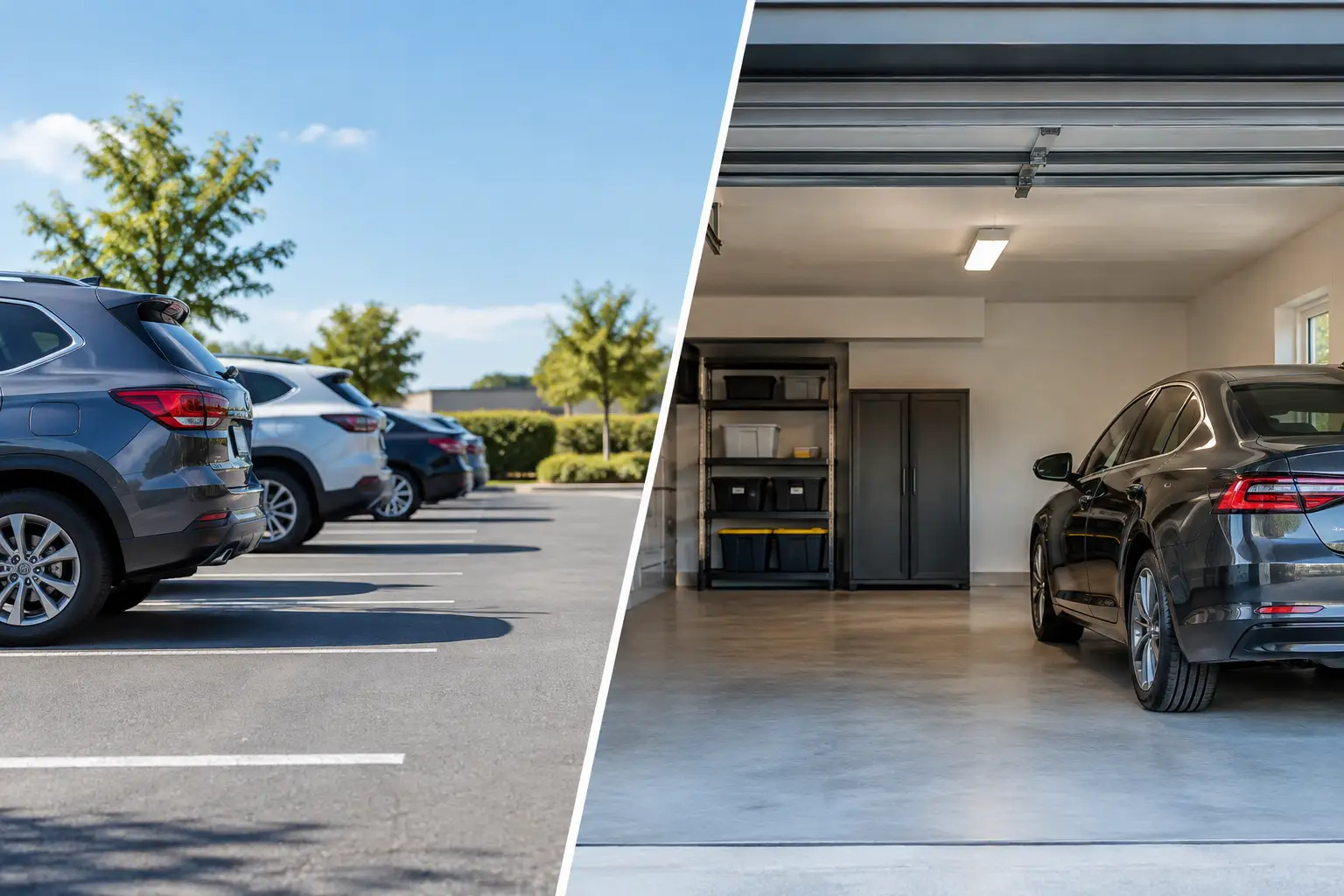
A spot a block from the door can be more valuable than a covered space 10 minutes away. That is the real decision behind private parking versus garages. Drivers need dependable access near work, home, events, airports, and busy neighborhoods. Property owners need a practical way to make an unused driveway, lot space, or reserved stall useful.
Neither option wins every time. A garage may protect a vehicle from weather and offer a more controlled environment. A private spot may save time, cost less, or put a driver exactly where they need to be. The right choice comes down to the trip, the vehicle, the location, and the level of certainty required.
Private Parking Versus Garages: The Core Difference
Private parking is a space controlled by an individual property owner, landlord, business, or small property operator. It can be a driveway, a dedicated space behind a building, an outdoor lot stall, or another clearly designated place to park. The main advantage is direct access to a location that larger parking systems may not serve well.
A garage is usually a purpose-built parking structure, whether it is public, commercial, residential, or attached to a property. Garages often offer covered parking, multiple levels, lighting, attendants, gates, or payment equipment. They are designed to handle a larger volume of vehicles, but they can also add walking distance, entry delays, and higher rates in high-demand areas.
The labels alone do not tell the full story. A private space can be gated, covered, monitored, and exceptionally convenient. A garage can be open, crowded, poorly maintained, or far from the destination. Compare the actual spot, not just the category.
Location Often Decides the Value
For most drivers, convenience starts with distance. A garage may be the best option near a downtown office, stadium, hospital, or airport when it is connected to the destination or runs around the clock. It gives drivers a known place to go in an area where curb parking is uncertain.
But a private space can be the better answer when the garage is not close enough. A homeowner’s driveway near a commuter rail station, a reserved stall behind an apartment building, or a business space close to a popular district can remove the longest part of the trip: circling the block and hoping something opens up.
This matters most for recurring needs. If someone parks near the same workplace three days a week, a dependable private spot may be worth more than a garage that is technically available but routinely congested at peak hours. For a one-time concert or weekend visit, a garage with clear signage and easy entry may be simpler.
For space owners, location is the asset. An ordinary open space near a place people already need to reach can have more practical value than a premium-looking space far from demand. The question is not whether the spot is impressive. It is whether it solves a real access problem.
Cost Is More Than the Posted Rate
Garage pricing can be easy to understand at first glance: hourly, daily, overnight, or monthly. Yet the final cost may change with event pricing, evening minimums, lost-ticket fees, taxes, or a rate that climbs after a certain number of hours. Some garages are a strong value for a short stay. Others become expensive when a driver needs routine parking.
Private parking is often priced around the use case. A driver may need one evening, several workdays, a monthly arrangement, or a spot during a local event. That flexibility can make an unused space a sensible option for both sides. The owner earns from capacity that might otherwise sit empty, while the driver pays for a location that fits the actual need.
Price should still be weighed against reliability. The cheapest garage is not a bargain if it fills before arrival. The cheapest private spot is not useful if its entry instructions are unclear or if the space is too tight for the vehicle. A good parking decision accounts for the full cost: the rate, the walk, the time spent finding the entrance, and the risk of being late.
Weather and Vehicle Protection
Garages usually have an edge when the weather is the deciding factor. A covered structure can limit exposure to sun, rain, snow, ice, falling branches, and debris. For longer stays, a vehicle that must be kept dry, or a trip during severe weather, that protection can be worth paying for.
Still, covered does not always mean protected in every way. Some garages have low-clearance levels, tight turns, limited ventilation, or spaces that are difficult for larger vehicles. Drivers with trucks, roof racks, vans, or oversized SUVs should check clearance and dimensions before committing.
Private parking can range from fully exposed to partially covered or enclosed. A private driveway may be ideal for quick access but offer no shelter. A dedicated space under a carport may provide enough protection for daily use. The useful question is specific: what does this vehicle need during this particular stay?
Security Depends on Details, Not Assumptions
Many drivers assume a garage is automatically safer than private parking. Sometimes it is. A well-lit garage with controlled entry, visible cameras, staff, and active traffic may create a stronger sense of security, especially late at night.
But large garages also have blind corners, multiple entrances, and constant turnover. A private space in a quiet residential area may have better visibility from nearby homes, a gate, a host who knows the property, or fewer unknown vehicles moving through. No option can guarantee security, so it is better to look for practical signals.
Drivers should consider lighting, access control, visibility, neighborhood activity, and clear arrival instructions. Owners should be honest about these conditions rather than making broad promises. If a space has a narrow entrance, limited overnight access, or no camera coverage, say so. Clear expectations help the right driver choose the right spot.
Access Can Make or Break the Experience
A parking space only works if a driver can enter, park, and leave without friction. Garages typically have marked lanes, established hours, and a familiar process. Their downside is the possibility of lines at gates, payment machines, elevator waits, or a slow exit after a major event.
Private spaces can be faster because they avoid a large facility altogether. A driver may pull into a reserved driveway or stall and walk directly to the destination. The trade-off is that directions need to be precise. Which entrance should be used? Is there a gate code? Is the space available overnight? Can the driver come and go during the reservation?
For owners, access instructions are part of the offering. A simple description, accurate photos, clear boundaries, and any needed timing details can prevent the most common problems. A spot is more valuable when someone can use it confidently on the first attempt.
When a Garage Is the Better Choice
Choose a garage when cover is essential, the vehicle will be parked for an extended time, or the destination is directly connected to the facility. Garages also make sense when a driver wants standardized operations, needs staffed assistance, or is traveling to an unfamiliar area where a large, clearly marked location reduces uncertainty.
They are especially practical for airport trips, dense downtown corridors, overnight stays during bad weather, and venues where exit routes and operating hours are well established. The convenience is often worth it when the garage fits the trip.
When Private Parking Is the Better Choice
Choose private parking when proximity, flexibility, and a reserved location matter more than a multi-level facility. It can be a strong fit for commuters, apartment residents, neighborhood visitors, workers with regular shifts, and drivers attending events where nearby garages are packed or priced at a premium.
It also creates a practical opportunity for property owners. A space that is empty during work hours, evenings, or weekends may meet someone else’s immediate need. Through Spot-Me.us, that basic exchange stays simple: your space, their need, one spot.
The best option is the one that removes stress from the trip. Before choosing, confirm the location, dimensions, access hours, coverage, price, and instructions. A clearly described private space or a well-run garage can both do the job. Pick the spot that gets you where you are going with the fewest surprises.